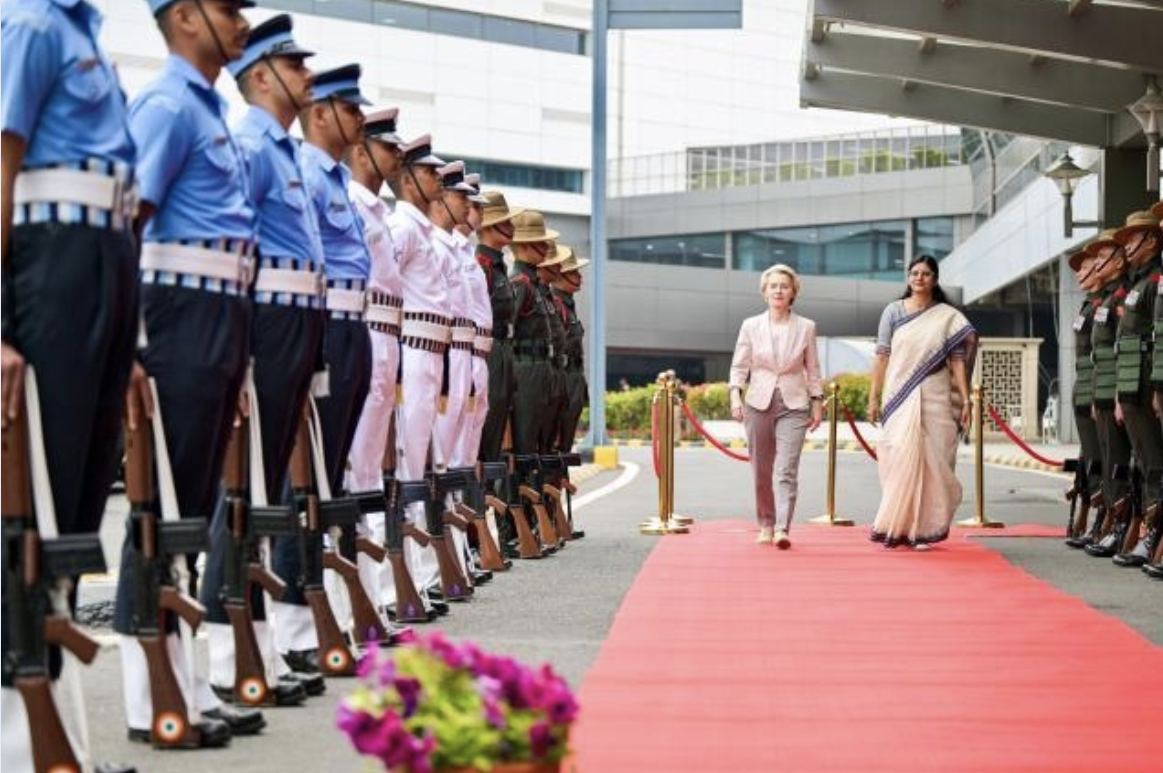
EU leaders are set to sign trade and defence agreements with India at a three-day summit next week, closing what European Commission president Ursula von der Leyen has described as the “mother of all trade deals”, officials said on Friday (23 January).
The agreement, part of a ‘New Strategic EU-India Agenda’ published by the commission last year, brings to a close several decades of stop-start negotiations.
Liberalising billions of euros of trade, the big winners are likely to be reduced tariffs on European cars and wine on the one hand, and expanded market access for Indian electronics, textiles and chemicals on the other.
In particular, India sees improved market access and lower duties as vital to its chances of closing the gap on China for its textiles and automotive sectors. The EU currently imports around €105bn of textiles per year, of which India currently accounts for five to six percent, compared to China’s 30 percent.
Von der Leyen told delegates at the World Economic Forum in Davos this week that the India agreement would be the “mother of all trade deals”.
Alongside the trade agreement is set to be an EU-India Security and Defence Partnership, which EU foreign affairs chief, Kaja Kallas, confirmed would be signed next week. That will create an EU-India Defence Industry Forum, bringing together companies and identifying areas of potential co-operation, with commission and Indian government officials attending as observers.
The EU wants to increase military cooperation with India, particularly maritime exercises in the Indian Ocean that, it believes, would complement the EU’s operations off the Horn of Africa.
![[Interview] ‘Some of the resistance comes from people fearing they’ll end up without a job,’ says industry expert on Europe’s slow electrification](https://static.euobserver.com/2026/07/anja-van-de-gronde-PY7r5dJ_v-Y-unsplash-2400x1602.jpg)
 Ukraine’s new French and Swedish jets will pose threat to Russia’s top warplanes (Ukraine Battlefield update: Day 1,605)
 Benjamin Fox