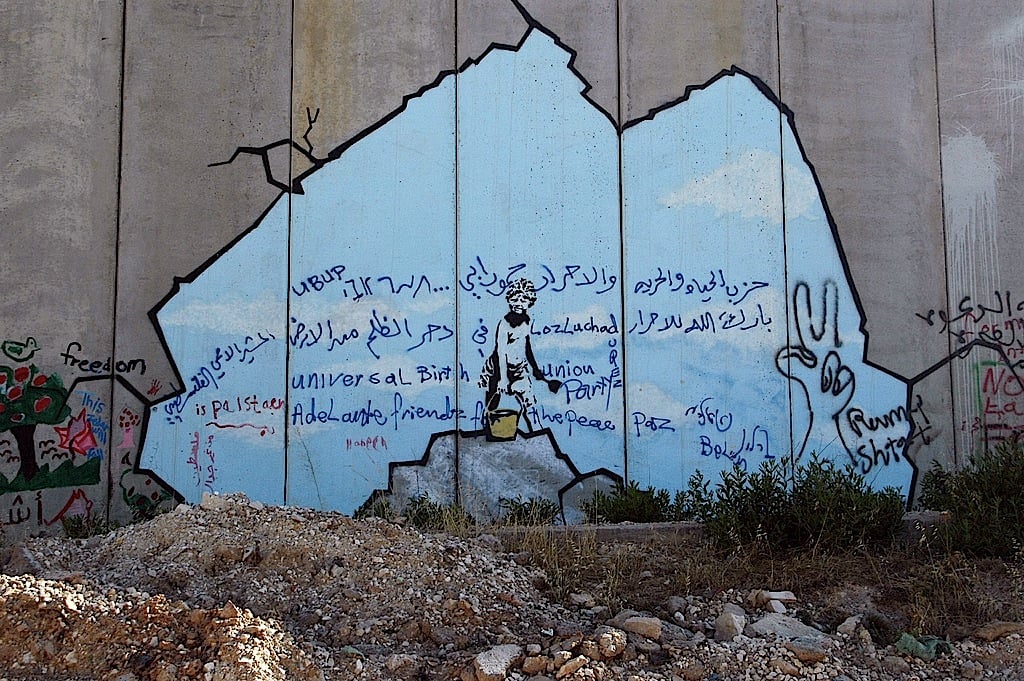
Ahead of the key meeting of EU foreign ministers on Monday (13 July), the European Commission has circulated an options paper exploring ways to restrict trade between the EU and Israeli illegal settlements in the West Bank.
This option paper follows calls from several member states for measures to comply with international law.
An import licensing regime, higher tariffs, and a trade ban on imports from Israeli settlements are the main options on the table for EU foreign ministers to discuss, several sources close to the negotiations told EUobserver.
And the legal basis for implementing the trade restrictions is at the heart of the debate, as it could open the door to a potential agreement that does not require unanimity – proven impossible to achieve in the past.
The pressure on the EU has intensified since the July 2024 International Court of Justice (ICJ) advisory opinion stated that countries have “the obligation … to abstain from entering into economic or trade dealings with Israel” concerning settlements in occupied territories and “take steps to prevent trade or investment relations that assist in the maintenance of the illegal situation”.
Six settler attacks daily
Two years on, the situation of Israeli settlements in the West Bank has worsened even further. Just in 2026, 680 attacks were recorded by the UN across more than 200 communities — an average of six settler attacks per day.
But the EU is deeply divided when it comes to Israel.
Countries such as France, Sweden, Spain, Belgium, and Ireland have been calling for a settler-import ban for months, while Israeli allies Germany, Austria, the Czech Republic, Hungary, and the new government in Slovenia are not in favour.
“There is no legal way to trade with illegal settlements, and no way to do that without feeding into Israel’s occupation and apartheid,” said Claudio Francavilla, from Human Right Watch.
“We should stop talking about “options” when only one of them complies with international law, and that’s a ban,” he added.
The legal basis for a trade ban?
In the confidential opinion paper, two possible legal bases for addressing trade with Israeli settlements are considered: one under foreign policy, which requires unanimity among member states; and another under trade policy, which would require a qualified majority vote (QMV).
Under QMV rules, measures can pass with the support of 55 percent of member states representing 65 percent of the EU population, allowing a bypass of potential vetoes from countries such as Germany, Austria and the Czech Republic.
But the commission has argued that measures aimed at changing Israel’s behaviour fall under foreign policy and therefore would require unanimity.
"These are options, not proposals - and that’s the trick. A proposal would force the Commission to state the legal basis and the voting rules. All three options are trade restrictions, which means qualified majority - not unanimity - applies. Keeping it vague is how you avoid that," said Alberto Alemanno, professor of EU law at HEC Paris and EUobserver columnist.
Using the trade route to impose a ban would not be straightforward either, as it would likely require Italy to reverse its long-standing pro-Israel position.
Diplomats estimated that 10 to 12 member states were in favour of banning imports from settlements, while a smaller group was open to considering the proposal.







 Ukrainian drones are wiping out Russian tankers in the Sea of Azov (Ukraine Battlefield update, Day 1,595)
 Elena Sánchez Nicolás