
A secretive network of officials within the European Commission is leading the push for more pro-deportation policies across the European Union amid intense political pressure to expel as many people as possible.
First launched in late 2022, the so-called High Level Network for Returns (HLNR) used the 7 October Hamas terror attack on Israel as a justification to enforce the exchange of data of individuals with a deportation order and flagged as “potential terrorists”, according to documents released through a freedom of information request.
The network also discussed setting up special charter flights to deport such individuals.
Made up of representatives from all member states and Schengen-associated countries, as well as the EU’s border agency Frontex and the EU’s asylum agency, the HLNR is tasked to “reinforce the coherence” of the Union’s efforts in increasing the number of people it deports.
Mari Juritsch, a Frontex veteran of almost 15 years, is HLNR chair and was chosen in March 2022 as the EU’s first Return Coordinator. The position was only recently created as part of the new EU-wide asylum rules that are being launched in June.
Juritsch, the European Commission and Frontex were all reached for comment. Juritsch did not provide a response at the time of publication.
The released documents also offer insights into how, only a few weeks after the fall of the Assad regime in Syria, the network called upon Frontex to start providing support for “voluntary” deportations to the country.
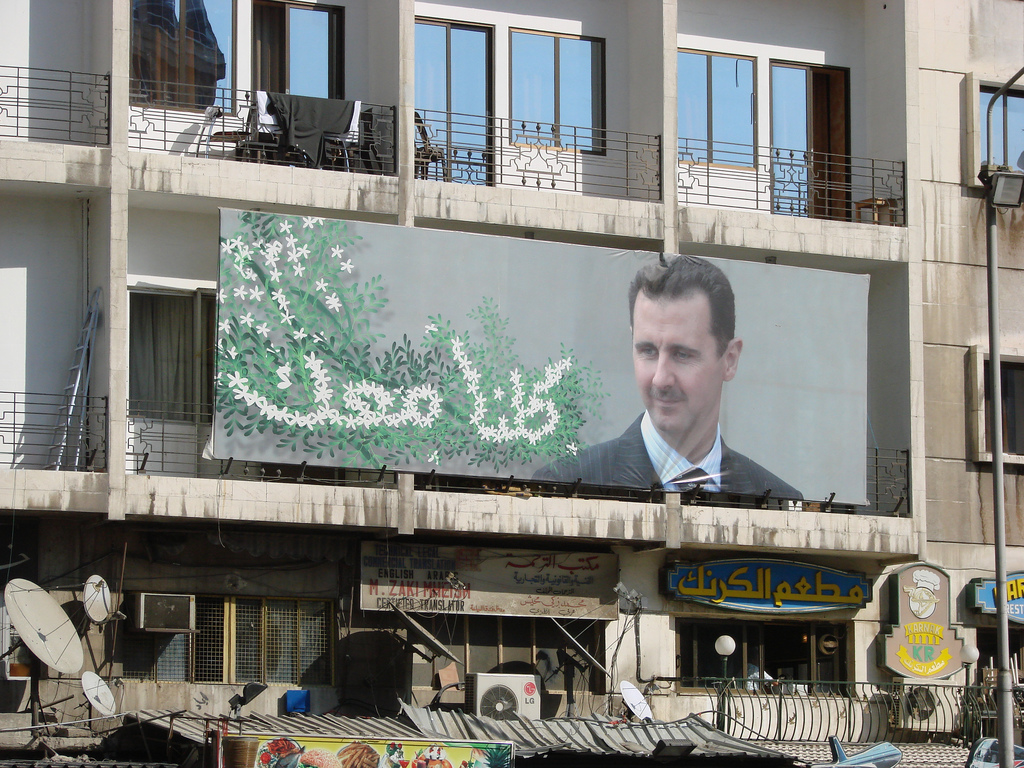
The Warsaw-based agency Frontex launched its voluntary returns programme for Syrians in March 2025, just days after sectarian violence killed more than 1,500 people and triggered new displacement, forcing thousands of Syrians into Lebanon.
The crackdown is part of a much wider effort by the European Union to expel people with no right to stay. And although “voluntary” returns have been a priority policy, the shift towards more coercive and forced deportations has also been endorsed by the HLNR.
Some of the HLNR policies would not only apply to people with rejected asylum applications; a vague definition of ‘terrorism’ could potentially be used against activists as well.
European lawmakers are set to vote on these policies on 9 March, as part of a new EU law on returns and as the latest flare up war in Iran risks triggering a refugee exodus and wider regional instability.
Talking behind closed doors
At its inception, the network designated itself as a platform for “informal” knowledge sharing between EU countries on best practices, as well as for identifying “common challenges and bottlenecks”, in order to carry out more deportations.
It adopted confidentiality rules to “allow participants to speak more freely”. As opposed to the more customary minutes mandated by the commission’s own rule book, only “short conclusions” from the meetings would be noted.

Two weeks after the 7 October terror attack in Israel, the network was called to discuss non-EU nationals “posing a threat to public policy, public order or national security”.
The meeting resulted in guidelines on how to use the Schengen Information System (SIS) to enforce deportation orders. SIS is an EU-wide police database for tracking so-called security threats.
Non-EU nationals with deportation orders were subsequently listed in SIS as of March 2023, making them accessible to police throughout the EU, as well as the EU’s police agency Europol and Frontex. Those deemed a security threat were flagged in the database.
The HLNR group guidelines were ultimately published by the commission in December 2024 as an “informal” document. Among other things, the document recommended using a “non-binding” definition of “potential terrorists” to justify data collection and sharing among member states.
According to London-based watchdog Statewatch, the definition was reportedly developed with no democratic oversight to target foreigners and climate activists.
Foreigners and climate activists
Statewatch researcher Romain Lanneau told EUobserver that linking support for Palestine with the enactment of pro-deportation policies “might be a good way to sell it in some cases, especially at the German level (…) There is potential, and certainly interest, to use SIS to target activists, especially politically active foreign nationals following the genocide in Palestine”.
Lanneau recounted the case of British-Palestinian surgeon Ghassan Abu Sitta, who received a Schengen entry ban in April 2024, after his public denunciation of the Israeli genocide in Gaza – declared a threat to Germany’s so-called free democratic basic order. A SIS alert was issued against him at the time, which reportedly prevented him from entering France to address its Senate a month later.
“This framing surrounding Palestine and people supporting it is just the tip of the iceberg where the authorities are abusing [the SIS] system,” Lannean added.
Syrians ‘go home‘
In late 2024, after a new EU commission was chosen, the EU Return Coordinator Mari Juritsch circulated a survey within the HLNR to assess the satisfaction of its members with the network.
One of the key takeaways was the desire to “elevate the strategic role” of the HLRN into more policy and decision-making. The network would soon get its wish.
In early 2025, the HLNR met twice to figure out how to facilitate the so-called voluntary return of Syrian nationals back to Syria. Despite the uncertainty after the regime change, Frontex was asked to start facilitating deportation flights to Syria, although it required the EU to change its policy on such returns.
Up until July 2024, the European Commission insisted that “safe, dignified and voluntary returns” to Syria would require “independent monitoring” from the UN Refugee Agency (UNHCR). Such monitoring is absent from Frontex’s returns programme.
Another hurdle was the lack of interest of the majority of Syrians to go back, potentially due to the level of insecurity in Syria. “UNHCR data indicates that only 27 percent of [redacted] living abroad intend to return within the next 12 months,” the meeting notes acknowledged. “The security situation remains highly volatile, with ongoing clashes in the north.”
However, by February, Frontex was ready: deportation flights back to Syria would be expensed from the agency’s €133m budget for returns in 2025.
The next month, the agency published a €4m tender to provide cash handouts and other financial assistance to up to 900 Syrian returnees and their families.
On 20 March 2025, the first Frontex-supported return operation to Syria would carry three people from Cyprus. By the end of the year, some 5,900 Syrian nationals would return from Europe with Frontex support. Almost half of them received some form of financial assistance from the agency.
When reached for comment, a spokesperson for Frontex told EUobserver that before the launch of its returns programme in Syria, “the agency assessed the situation in close coordination with its Fundamental Rights Office and in consultation with the European Commission.”
The spokesperson did not see the exclusion of UNHCR independent monitoring as an issue.
“[UNHCR and Frontex] operate under different mandates, legal bases, and governance structures,” they said. “[Frontex’ programme] operates within its own robust EU legal and oversight framework designed specifically for EU return and reintegration support actions.”
However, when asked whether the recurring waves of violence in Syria, which have killed more than 3,600 people in 2025, would be cause for suspending Frontex’s return operations to Syria, the spokesperson was quick to defer to national authorities, explaining: “Frontex does not decide whether a country is safe or not”.
“Frontex supports member states with individual voluntary returns to specific cities or regions, therefore an escalation in one part of the country does not automatically suspend support nationwide,” the spokesperson added.

Extreme but potentially ineffective
In June 2025, after the publication of the commission’s proposal for “more effective” deportations, EU Return Coordinator Mari Juritsch circulated within the network earlier findings from a €25m special fund to experiment with “innovative methods for incentivising voluntary returns”.
The fund was established in October 2024, after Italy, Austria, Cyprus, Czechia, Greece, Croatia, Slovakia and Slovenia called on the EU to declare parts of Syria safe for deportations. But because large-scale forced deportations to Syria were still not possible at the time, the commission decided instead to fund ways to encourage Syrians in Europe to go back voluntarily instead.
Some of the funding went to Italy’s interior ministry to be used for the deployment of 60 return counsellors from the UN mgration agency across the country, including inside the country’s Centres for Repatriation, at a cost of €4.6m to the EU taxpayer.
Meanwhile, Bulgaria’s migration directorate received €3.3m from the same fund, which it planned to use to hire 15 return counsellors, and subsidise the salary of 20 of its staff. The Guardian and Balkan Insight both reported on the coercive tactics used by Bulgarian officers to induce “voluntary” deportations, sometimes using violence.
Juritsch noted in her June 2025 email some of the “interesting ideas” that were being piloted, such as giving cash handouts to forcibly deported people to reward their cooperation with their expulsion, and deploying so-called return counsellors in detention centres.
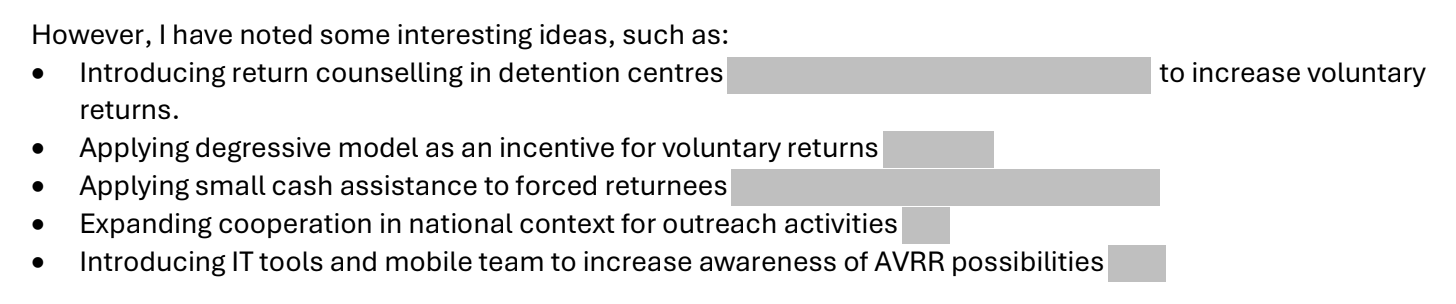
Antonella Patteri, research fellow at the Institute of Law Studies of the Polish Academy of Sciences, told EUobserver that many of these ‘ideas’ were not really that ‘innovative’.
“I find it somewhat euphemistic to refer to the ‘introduction’ of return counselling in return centres, as research clearly shows that this is already a well-established and institutionalised practice in several EU contexts,” Patteri said.
Patteri is part of a team of researchers currently engaged in a three-year EU-funded project that aims to improve the compliance of European migration policies with human rights. According to her, most of these solutions are likely to be ineffective in the long term.
“Research already shows that financial incentives in [return] programmes are rarely central to return decisions, which are more often shaped by long-term economic, legal, and protection concerns,” said Patteri.
Cash handouts in forced deportations can address short-term needs, “but rarely provide meaningful guarantees or improve long-term outcomes,” she added.
“This, I believe, reflects the fact that return policies are being increasingly guided by the need to escalate returns across the ‘deportation continuum’, therefore making potentially acceptable offers to returnees to, indeed, ‘return at all costs’,” Patteri said.
This publication was made possible with the support of the Dutch Fund for Special Journalistic Projects (Fonds Bijzondere Journalistieke Projecten).
Additional reporting support from Chris Jones and Hope Barker.








 THIS WEEK: Syria and Iran, plus national strikes in Belgium and Hungary’s new PM