Production: By Europod, in co-production with Sphera Network.
EUobserver is proud to have an editorial partnership with Europod to co-publish the podcast series “Briefed” hosted by Léa Marchal. The podcast is available on all major platforms.
Find the full transcript below:
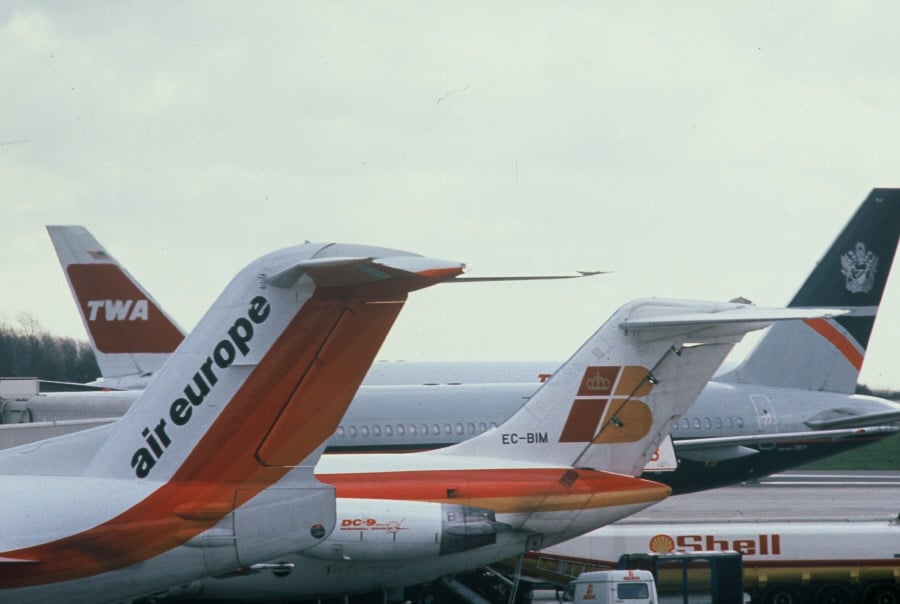
The aviation industry will probably miss its goal of reaching net-zero emissions by 2050.
That’s what Willie Walsh, director general of the International Air Transport Association, or IATA, recently acknowledged.
So if aviation can’t go green, does that mean that we, as consumers, should stop flying?
I’m Léa, and this is Briefed, your daily European podcast.
The aviation sector adopted its net-zero target in 2021 through IATA, the global airline industry association.
To get there, the industry was counting on two main solutions: more fuel-efficient aircraft and the large-scale use of sustainable aviation fuels.
But now, five years after setting that goal, industry leaders admit things are not going according to plan, casting a shadow on our hope to be able to continue flying without regrets.
The biggest challenge is sustainable aviation fuel, often referred to as SAF.
There are several types. Some are made from used cooking oils or agricultural waste — these are generally known as biofuels. Others are synthetic fuels, sometimes called e-fuels, produced by combining green hydrogen with carbon dioxide captured from the atmosphere.
Important to note that the aviation sector already has one major advantage: today’s aircraft engines can already operate using these fuels.
The problem is scale.
According to IATA, sustainable aviation fuels currently account for less than one percent of global jet fuel consumption. That’s a long way from the roughly 65 percent contribution that the industry expects them to make by 2050.
Production is growing, but not nearly fast enough.
Why?
First, these fuels remain significantly more expensive than conventional jet fuel.
Synthetic fuels, for example, require green hydrogen. And green hydrogen is still produced in very limited quantities because making it requires large amounts of renewable electricity and the process remains expensive.
Biofuels face a different challenge. While they are already widely present in the industry, some experts worry that producing them on a massive scale could compete with food production. In other words, land that could be used to grow food might instead be used to grow crops for fuel. The same concern applies to fertilizers that are needed to grow crops, and which are already under pressure.
So that’s where things stand on alternative fuels.
Now, what about technological innovation?
You may have heard about electric aircraft, for example.
The reality, though, is that electric aviation is currently limited to very small aircraft and short regional routes. It is not a realistic solution anytime soon for large commercial airliners, cargo planes, or long-haul flights.
So if we can’t make aviation fully clean, does that simply mean we need to fly less?
It’s a debate you’ve probably heard before.
Aviation is responsible for roughly two to three percent of global carbon dioxide emissions.
But if you also consider the effects of flying at high altitude — including contrails and other atmospheric impacts — aviation’s contribution to global warming rises to around four to five percent.
That may not sound like much.
But given the scale of emissions reductions needed worldwide, and the urgency of the climate challenge, every source of emissions deserves attention.
Which is why some people around you might have taken the decision to stop flying completely.
French engineer Jean-Marc Jancovici, for example, thinks we should only be allowed four flights in our entire lives.
For some people, that sounds like an unacceptable restriction.
For others, it’s a necessary response to climate change.
Governments are also starting to act.
In France, since 2023, certain domestic flights have been banned whenever a train can make the same journey in less than two and a half hours.
At the European level, however, there is currently no broader framework aimed at reducing air travel demand.
Where the European Union has taken action is on sustainable fuels. Airlines are gradually being required to increase the share of sustainable aviation fuel they use, with the supply challenges I mentioned earlier.
Another idea that regularly comes up is a tax on kerosene.
Unlike the diesel or gasoline used by motorists, the fuel used for commercial aviation is generally exempt from taxes.
The issue has been debated for years, but so far there is no political consensus in Europe on introducing a broad kerosene tax.
For now, that means much of the power remains in the hands of consumers.
Not necessarily to stop flying altogether, but perhaps to fly less often.
 Von der Leyen may be caving to Meloni, but on green investment, relaxing EU deficit limits is exactly right